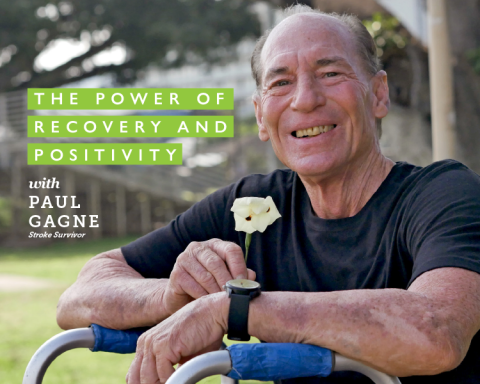
If you are waiting for a malasada outside Leonard’s Bakery or catching TheBus in Kapahulu, you might just run into Paul Gagne. You won’t miss him; he’s the one smiling at you.
For Paul, walking isn’t just a physical necessity; it is a social mission. He calls them his "mindful walks," and they are his way of reintegrating into the world with joy, striking up spontaneous conversations and smiles. He takes note of the butterflies and the bushes, but mostly, he notices the people. Whether it’s a local resident or a group of tourists, Paul speaks what he calls the "universal language of love."
"I’ve never met a stranger," Paul says. "I’m just at home walking into a party not knowing anyone as I am walking into a family reunion."
This ability to connect with anyone, anywhere, is a sign of how far Paul has come. After surviving a stroke in late 2024, his goal wasn't just to survive—it was to thrive. He wanted to get back to the things that made life fun, like hitting the golf course.
Getting Back in the Swing of Things
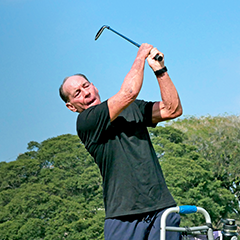
Reintegration means returning to the hobbies that bring you joy, and for Paul, that meant golf. Thanks to the mobility and confidence he regained during his recovery, Paul recently celebrated a major milestone: a day out golfing with friends.
"We went out, did lunch, goofed off and played golf," Paul recalls with delight. The fun didn’t stop at the fairway; he even headed to a glow-in-the-dark driving range later that day. For a stroke survivor who once feared he might not walk independently again, swinging a golf club and laughing with friends at a driving range isn't just recreation—it’s a victory.
Choosing the Best Chance for Recovery
These moments of community connection were built on a foundation of hard work at REHAB Hospital of the Pacific (REHAB). When Paul was weighing his options after his stroke, he didn't just look for a place to stay; he looked for the place that would give him the best outcome. He learned that REHAB is Hawaii’s only licensed acute inpatient rehabilitation hospital, distinct from skilled nursing facilities (SNFs) because of its intensity and expertise.
Paul didn't shy away from the hard work—he welcomed it. "They told me REHAB was for people who really want to get better—and that’s where I wanted to be!" Paul says.
While SNFs might offer therapy sessions of an hour, Paul committed to REHAB’s standard of at least three hours of physical, occupational and speech therapy every single day, 5 days a week (or 15 hours/week). Supported by a multidisciplinary team of rehab doctors (who saw him regularly), nurses and therapists collaborating on his care, Paul embraced the challenge.
"I said, 'Sign me up!' I was determined to recover as much as possible."
"You reach this pivotal point in recovery where you are making advancements. If you cut the line there, you may stop progressing. I didn’t want to fall through the cracks."
Staying REHAB Strong
Paul also received outpatient care at REHAB and after completion, he refused to let his progress stall.
"You reach this pivotal point in recovery where you are making advancements," Paul explains. "If you cut the line there, you may stop progressing. I didn’t want to fall through the cracks."
He found his solution in REHAB Strong, a wellness program designed to bridge the gap between medical treatment and independent fitness. It became his safety net, allowing him to maintain the leg strength required for golfing and those long community walks.
A Full Life
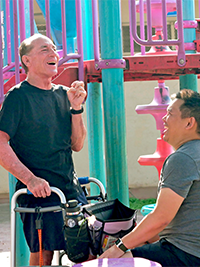
Paul has fully embraced the continuum of care at REHAB to fuel his active lifestyle. Beyond the gym, he participates in REHAB’s adaptive sports programs. You can find him powering through Adaptive Cycling on a recumbent tricycle he affectionately calls the "Batmobile," or participating in Adaptive Swimming.
"We talk story, we laugh and we network," he says of the adaptive sports programs. "That fosters self-confidence and fulfillment."
Today, Paul has transitioned from a patient who needed help to a community member who gives it. He volunteers at REHAB to stay connected to the "magical" staff who saved his life, and he attends REHAB’s Stroke Support Group—always bringing donuts or desserts to encourage other participants to stick around to chat.
From making tourists smile in Kapahulu to hitting the driving range, Paul Gagne is living proof that with the right support, life after a stroke can be full of movement, friendship, community and aloha.
Help us continue this work of healing with aloha. Support REHAB by making a gift below: