When you picture physical therapy, you might imagine weights, resistance bands, and parallel bars. While those are still valuable tools, the world of modern rehabilitation has evolved. Today, recovery is being supercharged by cutting-edge technology designed to retrain the brain and body in ways that were once impossible.
At REHAB Hospital of the Pacific, we are committed to investing in the most advanced rehabilitation technology to give our patients the best possible chance for a faster, more complete recovery.
This is a behind-the-scenes look at some of the innovative tools our expert therapists use to help rebuild lives.
More Than Machines: The "Why" Behind the Technology
Advanced rehab technology isn't about replacing therapists; it's about giving them powerful tools to accelerate the body's natural healing processes. The core principle behind many of these innovations is driving neuroplasticity through thousands of repetitions.
Think of it like a flight simulator for your body. These tools allow you to safely and repeatedly practice complex movements like walking or grasping, helping your brain and muscles relearn and reconnect faster and more efficiently than with traditional therapy alone.
Spotlight on Innovation: Our Advanced Rehabilitation Tools
Here are a few of the state-of-the-art technologies you'll find at REHAB Hospital, from tools that heal the body to those that sharpen the mind.
Technology for Physical Recovery
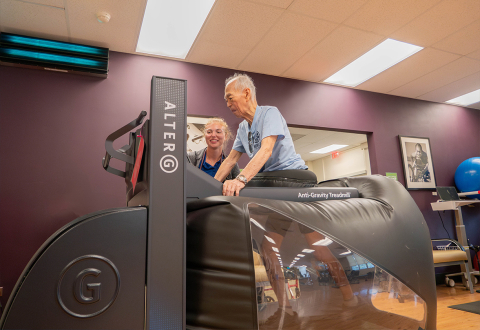
- The AlterG® Anti-Gravity Treadmill™: This game-changing treadmill uses air pressure to "unweight" a patient by up to 80% of their body weight. This allows individuals recovering from orthopedic surgery or spinal cord injury to practice walking with a normal gait, without pain, much sooner in their recovery.
- Functional Electrical Stimulation (FES) Bikes: For patients with paralysis, FES technology uses gentle electrical impulses to activate muscles in a patterned movement, like pedaling a bike. An FES bike for spinal cord injury or severe stroke can help maintain muscle mass, improve circulation, and retrain neural pathways.
- Bioness® and Wearable Robotic Rehabilitation: These wearable devices use stimulation to help patients move a hand or foot. The system is a powerful tool for stroke survivors working to open a paralyzed hand or for those using Bioness for foot drop, a condition that makes walking difficult.
Technology for the Mind: Cognitive & Communication Rehab Tools
Effective neuro rehabilitation technology also focuses on healing the brain. Our therapists use specialized software and computer-based programs to help TBI and stroke survivors retrain crucial cognitive skills such as:
- Memory
- Attention and concentration
- Problem-solving
- Speech and language processing
Rehab Technology at a Glance
Here is a quick summary of what our key technologies do and who they help most:
- AlterG® Anti-Gravity Treadmill™
- What It Does: Reduces body weight using air pressure to allow for safe, early walking.
- Who It Helps Most: Orthopedic, SCI, and trauma patients.
- FES Bikes
- What It Does: Uses electrical stimulation to move paralyzed leg muscles in a cycling pattern.
- Who It Helps Most: SCI and stroke survivors.
- Bioness® System
- What It Does: A wearable device that helps lift a foot ("foot drop") or open a paralyzed hand.
- Who It Helps Most: Stroke and TBI survivors.
- Cognitive Software
- What It Does: Computer-based programs and apps to retrain memory, attention, and problem-solving.
- Who It Helps Most: TBI and stroke survivors.
The Human Element: Technology is Only as Good as the Therapist
These incredible tools are not a replacement for the expertise of a trained therapist. At REHAB Hospital, our physical and occupational therapists are the "pilots" of this technology. They are the ones who perform the expert assessments, create the personalized treatment plans, and know exactly how and when to use these tools to maximize your recovery.
Frequently Asked Questions
- Is this technology used for every patient? Not necessarily. Your specialized care team, led by a physiatrist, will determine which tools, if any, are appropriate for your specific condition and recovery goals.
- Is this type of therapy painful? No. While the therapy is intensive, these technologies are designed to be used safely and comfortably under the constant supervision of an expert therapist.
- How do I know if I'm a candidate for this type of rehab? The first step is a comprehensive evaluation. If you have experienced a major injury or illness, talk to your doctor about a referral to a certified Inpatient Rehabilitation Facility (IRF) where this level of care is available.\
Choose the Future of Rehabilitation
Your recovery deserves the best and most effective care available. To learn more about the field of assistive technology, organizations like the are a great resource.
At REHAB Hospital of the Pacific, we are proud to bring the future of rehabilitation technology to Hawaii.